
The move represents a sharp repricing of Japan’s short-term rates. The two-year yield stood near 0.85% in August 2025, meaning it has roughly doubled over the past year. After spending much of April-June around 1.35%-1.45%, it broke higher in July and accelerated above 1.6% in August.
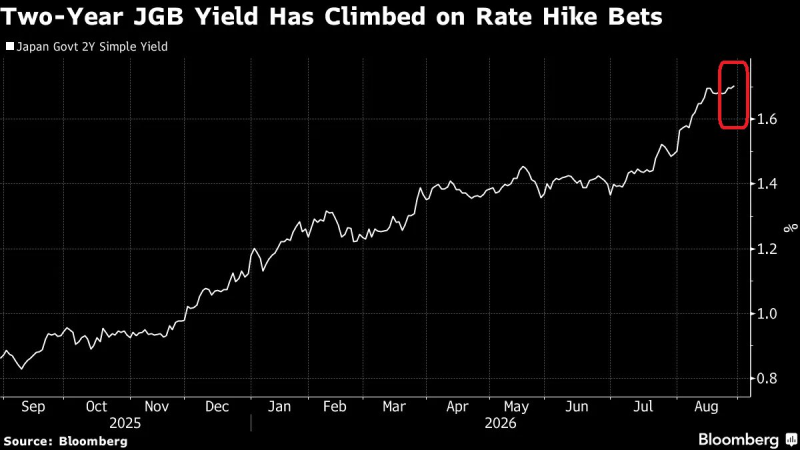
The two-year maturity is particularly important because it is highly sensitive to expectations for BOJ policy. Its latest rise suggests investors are pricing not just one additional rate increase, but a higher path for Japanese interest rates over the coming quarters.
BOJ Expectations Drive the Move
The BOJ raised its policy rate to 1% in June, continuing the normalization process that began with the end of negative interest rates.
Attention has now shifted to the September policy meeting. Economists increasingly expect another 25-basis-point increase to 1.25%, while market pricing has recently implied a high probability of such a move.
Inflation remains the main justification for further tightening. Tokyo’s underlying inflation measure excluding fresh food and fuel accelerated to around 2% year-on-year in August, keeping price pressures close to the BOJ’s target.
The weak yen adds another complication. Currency depreciation raises the cost of imported energy, food and raw materials, potentially sustaining inflation and increasing pressure on the BOJ to tighten policy.
The Repricing Is Spreading Across the JGB Market
Higher yields are not confined to the two-year maturity. Japan’s 10-year government bond yield has approached 3%, while the 30-year yield has moved above 4%, reflecting both higher policy-rate expectations and reduced BOJ support for the bond market.
That marks a major change for an economy where interest rates were held near or below zero for much of the past two decades.
Higher domestic yields also have implications outside Japan. Japanese banks, insurers and pension funds are major investors in foreign bonds. As JGB yields become more attractive, the incentive to hold U.S. Treasuries and European debt, particularly after currency-hedging costs, declines.
The two-year yield near 1.7% therefore captures a broader shift: markets are increasingly treating Japan as an economy moving toward structurally higher interest rates rather than temporarily escaping negative rates.
For the BOJ, the September meeting will test whether policymakers are prepared to follow a bond market that has already moved decisively toward further tightening.