Yuriy Ukazkin

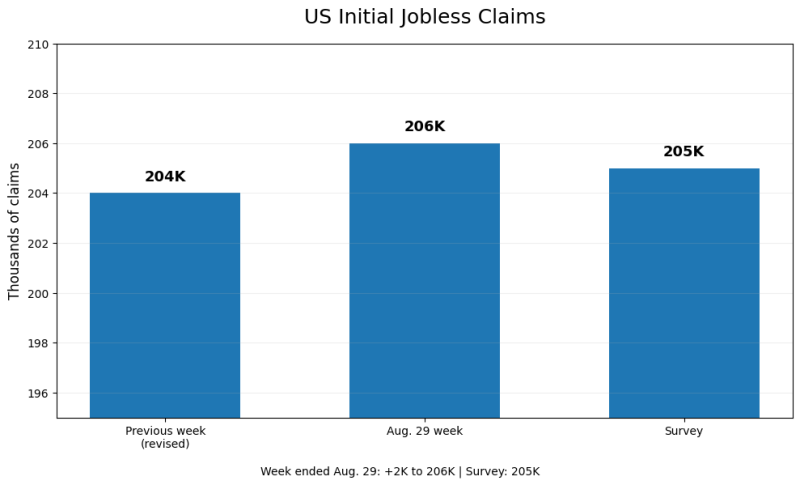
The previous week's reading was revised to 204,000. The increase was marginal, leaving claims at levels consistent with limited layoffs across the US economy.
Continuing Claims Increase
Continuing claims rose by 8,000 to 1.779 million in the week ended August 22. The gap between initial and continuing claims is notable. New filings remain low, suggesting employers are not significantly increasing layoffs, while the rise in continuing claims points to longer unemployment spells for some workers.
In practical terms, the labor market is showing more weakness in reemployment than in job destruction.
Hiring Is the Bigger Risk
Initial claims at 206,000 do not signal a broad increase in corporate layoffs. The reading was only 1,000 above expectations and just 2,000 higher than the revised prior week.
Continuing claims provide a different signal. A sustained increase would indicate that workers who lose jobs are having more difficulty finding new positions. This distinction matters in a labor market where companies can reduce headcount growth by slowing recruitment rather than cutting existing jobs.
The result can be weak employment growth without the sharp rise in initial claims normally associated with recessionary conditions.
Fed Policy
The report does little on its own to strengthen the case for aggressive Federal Reserve easing. Initial claims remain low enough to suggest that restrictive monetary policy has not triggered a significant increase in layoffs.
The 1.779 million continuing-claims reading is more relevant for assessing labor-market deterioration. Further increases, particularly alongside weaker payroll growth or higher unemployment, would provide stronger evidence that labor demand is weakening.
For the Fed, the distinction is between a gradual slowdown in hiring and an outright increase in job losses. The latest claims data remain closer to the first scenario.
Treasuries, Dollar and Equities
The 206,000 reading versus a 205,000 forecast represents only a small downside surprise and is unlikely to materially change rate expectations by itself. For Treasuries, low initial claims limit the case for a labor-driven decline in yields.
For the dollar, the absence of a sharp deterioration in employment reduces pressure from expectations of faster Fed easing. For equities, contained layoffs reduce near-term recession risk, although weaker hiring and rising continuing claims could become a headwind if the trend persists.
The latest figures show a labor market with low layoffs but increasing difficulty returning to work: initial claims stand at 206,000, while continuing claims have risen to 1.779 million.
 Yuriy Ukazkin