Alex Borzak

The stock tells the opposite story. Salesforce shares recently traded at $205.62, compared with a peak of roughly $350–$360 in early 2025. That leaves the stock about 42% below its peak even though EPS has continued to rise.
The divergence has widened sharply over the past six quarters.
| Quarter | Diluted EPS | Change |
| Q2 2024 | $5.56 | — |
| Q3 2024 | $5.75 | +3.4% |
| Q4 2024 | $6.08 | +5.7% |
| Q1 2025 | $6.36 | +4.6% |
| Q2 2025 | $6.39 | +0.5% |
| Q3 2025 | $6.88 | +7.7% |
| Q4 2025 | $7.48 | +8.7% |
| Q1 2026 | $7.80 | +4.3% |
| Q2 2026 | $8.63 | +10.6% |
| Q3 2026 | $10.96 | +27.0% |
The latest quarter produced the largest sequential EPS increase in this stretch: $2.33 per share, or 27%.
EPS is up 508% from 2021
The longer-term comparison is even more pronounced. Salesforce reported diluted EPS of $1.81 in Q4 2021. At the time, its shares were around $275.26.
By Q3 2026:
- diluted EPS had increased to $10.96, up 508%;
- the share price had fallen to $205.62, down 25.3%.
Salesforce therefore generates roughly six times as much diluted EPS per share as it did in late 2021, while its stock trades about $70 lower.
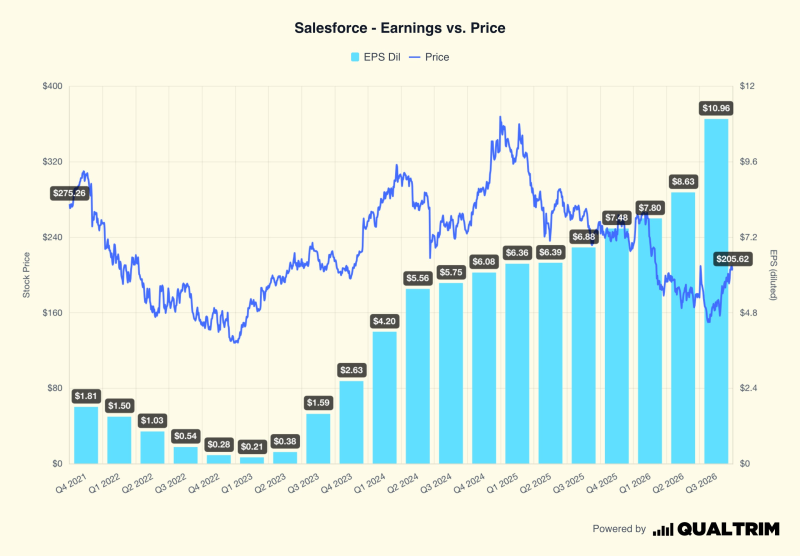
The 2023 earnings trough is gone
The EPS deterioration that accompanied the 2022 software selloff bottomed in Q1 2023.
Diluted EPS fell: $1.81 → $1.50 → $1.03 → $0.54 → $0.28 → $0.21
From that $0.21 trough, Salesforce then produced 14 consecutive quarterly increases in the figures shown on the chart: $0.38 → $1.59 → $2.63 → $4.20 → $5.56 → $5.75 → $6.08 → $6.36 → $6.39 → $6.88 → $7.48 → $7.80 → $8.63 → $10.96.
EPS has increased by approximately 5,119% from the Q1 2023 low. The stock initially followed. Salesforce shares recovered from roughly $130 in early 2023 to around $350–$360 by early 2025, an increase of approximately 170%. But earnings and price subsequently separated.
Since early 2025, EPS +72% and stock roughly -40%
Q1 2025 provides a useful reference point. Diluted EPS was $6.36. Since then it has climbed to $10.96, an increase of 72.3%. During approximately the same period, the stock moved from its $350-plus peak to $205.62.
This means Salesforce has added $4.60 of quarterly diluted EPS per share while losing roughly $145–$155 per share in market price. That is a major valuation reset rather than an earnings contraction.
The market is paying much less for each dollar of earnings
The Q4 2021 and Q3 2026 figures illustrate the compression. Using the quarterly EPS figures directly as a simple price-to-quarterly-EPS comparison:
| Q4 2021 | Q3 2026 | |
| Share price | $275.26 | $205.62 |
| Diluted EPS | $1.81 | $10.96 |
| Price / quarterly EPS | 152.1x | 18.8x |
This is not a conventional P/E ratio, since standard P/E calculations normally use trailing or forward annual earnings. It is useful here only as a like-for-like measure of how the relationship between the two series has changed.
On that basis, Salesforce's price relative to quarterly EPS has contracted by approximately 88% since Q4 2021.
The latest EPS jump makes the gap more extreme
The most important data point on the chart is Q3 2026. EPS increased 27.0% quarter over quarter and 59.3% year over year to $10.96.
For comparison:
- Q3 2025: $6.88
- Q4 2025: $7.48
- Q1 2026: $7.80
- Q2 2026: $8.63
- Q3 2026: $10.96
Across those five quarters, EPS increased by $4.08, or 59%. Yet Salesforce shares are currently near $206, well below both the approximately $275 level shown in late 2021 and the $350-plus peak reached around early 2025.
The chart therefore shows a clear shift in Salesforce's investment case: earnings are no longer the weak point. Valuation has compressed despite accelerating EPS growth.
For the stock to return to its approximately $350 peak, it would need to rise about 70% from $205.62. Even returning to the Q4 2021 price of $275.26 would require a gain of roughly 34%. That is the gap Salesforce's future growth now has to close.
 Alex Borzak